Showing posts with label Non-fiction. Show all posts

Wednesday, 9 April 2014

The Year That Changed the World, by Michael Meyer

Why I read it: Economist Review

Podcast: C.V. Starr Center, which you can find on iTunes

Brow: High, even higher if you've actually been to Berlin.

Summary: Meyer was Newsweek's Eastern Europe correspondent in the 80s and was a firsthand witness to the extraordinary events that led to the fall of communism in Eastern Europe and its most hated symbol, the Berlin wall. He walks us through each country's transition, from Poland's first free elections in 1981 to a blunder at a press conference by a communist party spokesperson in East Berlin in 1989 that led to the wall being opened that very night, with liberal sprinklings from Hungary, the former Czechoslovakia, and Romania thrown in for good measure.

But should you read it? If you've kind of heard of this thing called communism but aren't really sure what it was or why some parts of Europe seem so much poorer than say, Sweden or France, this is a great book to walk you through what happened. It's also short enough that it won't take you very long to read it.  Although this book was published before the Arab Spring, another interesting reason to read it is parallel between the fates of the countries that broke free of the Iron Curtain and what is currently happening now in the Middle East. Some of the revolutions were relatively peaceful (Czechoslovakia, Germany, Tunisia); others somewhat messy (Romania, Egypt) and still others led to years of civil war (the Balkans, Syria). It will be interesting to see where everything ends up in another 40 years. If you're looking for an in-depth country-by-country analysis of the collapse of communism, this isn't your book.

Sunday, 23 March 2014

Pakistan: A Hard Country, by Anatol Lieven

Why I read it: Economist Review

Podcast: LSE Public Events

Brow: Upper middle, unless you're a Pakistani reading this in Pakistan... well, actually you'd still be upper middle brow to be reading this in Pakistan, since the literacy rate is only 56%.

Summary: It's basically everything you need to know about modern Pakistan, from how the society is ordered and governed to how each region functions both internally and in relation to the others.

But should you read it? I recognise that foreign affairs is not most people's cup of tea, and that Pakistan is very foreign to most people, which allows us to tell ourselves that it's somehow unimportant or uninteresting. But that doesn't mean it's true. In fact, Pakistan is of immense geopolitical and geostrategic importance, and the fact that many in the west try to dismiss it as a mere 'failed state' belies that importance. It also helps that this book is well-researched and full of fun tidbits, like the fact that Pakistan's feudal politicians now complain that they have to convince their vassals to vote for them, whereas once a bribe or even the threat of cancelling their tenancy were enough.

Saturday, 22 February 2014

Faber Pocket Guide to Wagner, by Michael Tanner

Why I read it: Although I didn't have the sitting capacity to sit through the 16 hours of opera in 4 days that an entire Ring Cycle would demand, I did manage to see Die Walkure in Amsterdam this month and thought I should have at least some idea of what I was watching.

Podcasts: There are many on Wagner, mostly focusing on whether his racism led to Nazism, but none on this book specifically.

Brow: People think that opera is intimidatingly high-brow because it's mostly in a foreign language, but actually the plots are quite simple, and frankly goofy, and that, in combination with the costumes, set and the fact that a character will often take 25 minutes to die on stage, makes it more kitsch than high art. Nonetheless, as long as it retains its reputation as being an expensive, difficult art form reserved for the moneyed set, it will remain in its rarefied brow ranking.

Summary: The book starts with a short biography of Wagner, a notoriously difficult man, then analyses his operas, then finally deals with his antisemitism and whether it led to the Holocaust.

But should you read it? It's the Wagner 200 year, and so you can expect to see a lot of advertisements for his operas, especially since, racism or no, it's the one way opera houses can guarantee they will sell out for at least a few nights. If those adverts do arouse your curiosity, by all means buy this book so you'll have some idea of what you're watching and the fevered, brilliant, temperamental (he hated France nearly as much as he hated Jews, for not liking his operas) mind it sprang from.

Sunday, 16 February 2014

Sybil Exposed, by Debbie Nathan

Why I read it: Salon review

Podcasts: None

Brow: It was a sordid case of psychiatry and journalism gone mad that inevitably became hugely popular. Writing a biography that exposes that fact does not elevate it above low brow.

Summary: In the 1970s, a book called Sybil appeared, the supposedly true story of a woman who had 16 personalities and the psychiatrist who put her back together. The book launched a new psychiatric diagnosis: Multiple Personality Disorder, in which a person's psyche 'splits' as a way to cope with severe sexual abuse, usually Satanic in nature. Each new personality periodically takes over the brain and body of the host, leaving her (the overwhelming majority of sufferers were women) with large tranches of time that she can't remember. For the next 20 years or so, MPD, repressed memories and Satanic cults were a popular trend in psychiatry and daytime talk shows, until society finally came to its senses in the 1990s and realised that the phenomenon was largely made up. Debbie Nathan researched the three women behind the craze: the original 'Sybil', her psychiatrist, Connie Wilbur, and the journalist who helped them sensationalise their story. She traces 'Sybil's' (real name: Shirley Mason) journey from being a misfit in her Seventh-Day Adventist community in Iowa to troubled college student in New York who falls under the spell of an ethically-challenged psychiatrist named Connie Wilbur, who was looking to make a name for herself using the new drugs and treatments available to her profession, namely hypnosis, sodium pentothal or 'truth serum', barbiturates and insulin. She quickly turned her patient into a junkie and forced her to make up ever more outlandish tales about her childhood in order to keep her attention. The journalist had made a name for herself publishing human-interest stories about politicians' wives, but as public interest waned, she needed a new hook for her audience. This toxic combination yielded Sybil.

But should you read it? I was a little young to understand the whole 'Satanic ritual abuse' craze at the time it was happening, but I was a little more politically aware by the time it was being exposed as a giant hoax propagated by paranoid prosecutors and overzealous psychiatrists. I also studied psychology at university, where this was held up as the classic case study of therapeutic overreach. It's also a good reminder to all of us that mass hysteria is not a new phenomenon and we need to be careful about falling prey to it all the time, regardless of our experience with psychiatry.

Tuesday, 11 February 2014

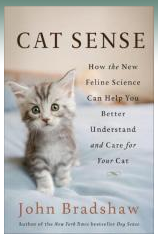
Cat Sense, by John Bradshaw

Why I read it & Podcast: Fresh Air

Brow: Since cats are the highest brow, reading books about them must be impossibly high.

Summary: Bradshaw is an anthrozoologist at the University of Bristol and owner of 3 cats, though this book is largely the result of his actual research into cat behaviour and emotions. He argues that cats are not nearly as far along in their evolution from pest controllers to purr factories, and the lifestyle we expect them to lead now, where they are pampered, worshiped, and in my case at least, literally brought food on a platter, food that is often more expensive on a per-kilo basis than my own, I might add, is actually stressing them out, because we expect them to live in close proximity to other cats and not claw our furniture in exchange for the above. The book is also stuffed full of tips for the cat owner, such as how to tell what your cats think of each other (mine get along fine) and what kinds of toys they like (the ones they know they've killed because they fell apart. He does not explain how you are supposed to afford this).

Who should read this: Well, obviously anyone who has a cat, which is now the most popular domestic pet today, so that's a lot of people. You can probably skip the history chapters if you're looking for a quick read, but the behaviour, interaction and emotions chapters are indispensable reading for the ailurophile.

Monday, 20 January 2014

Far from the Tree, by Andrew Solomon

Why I read it: New Yorker Review but this guy was everywhere for a few weeks.

Podcasts: CBC Ideas, but it's just one of many.

Brow: If you're reading it for stories about freaky kids, low brow, but if you're trying to understand the experience of their parents, middle.

Summary: Most parents expect to pass on their way of being happy, or their 'vertical identity' to their children. But what happens when it's impossible to do that? Solomon explores what happens when children are drastically different from their parents in a dozen different ways, from deafness to criminality to transgenderism, so those identities become 'horizontal.' He tells us the personal stories of hundreds of families he interviewed over 10 years while researching the book.

What I liked about it: The book is fantastically written and the stories are well told, whether it's the heartbreaking scene of a mother whose child is the product of rape asking Solomon to tell her how to love her child, or the uplifting stories of parents who become advocates for their children. It's also packed with interesting facts, like that schizophrenia is a developmental disorder, not a mental illness.

What I didn't like about it: The text of the book is over 700 pages, and with footnotes it comes out to nearly 1000 pages. The stories are great, but each chapter is at least 50 pages, and some are nearly 90. It felt like this book could have been tightened a lot and not lost any of its power. Furthermore, although Solomon talks about how people who would have been bad parents become awful parents when they are faced with a child they can't identify with, he gives us almost no stories of people in those situations, and doesn't appear to have interviewed any of them. Perhaps he couldn't get anyone to agree to sit down to an interview about what a terrible parent they are, but it's hard to see how anyone having a horrific time with a similar case to one of these wouldn't feel inadequate. Adding to this is the fact that nearly everyone he profiles is middle class and above, when I imagine it would be much harder for a working-class single mother to find the time and energy to advocate for her special-needs child, but we don't get many of their stories.

Sunday, 19 January 2014

Love to Love you Bradys, by Ted Nichelson, Susan Olson and Lisa Sutton

Why I read it: Salon Review

Podcasts: Amazingly, yes, there is a podcast for this book, but not for Robertson Davies.

Brow: Low, but like, hipster-cool lowbrow.

Summary: In 1976, television hit its nadir. Not only were variety shows all the rage, it looked like variety shows starring large families were about to take off, since The Donny and Marie Show was a hit. So superproducers Sid and Marty Krofft cast about for another large TV family that might possibly be trained to sing and dance and came up with The Brady Bunch, which had gone off the air a few years before. They reassembled most of the cast and set about turning them into vaudevillians. Somehow, this managed to stay on the air for 10 episodes. Like I said, nadir. Anyway, more than 30 years later, fans were still so curious to know the answers to such questions as 'Why didn't Eve Plumb participate?' that the authors were able to generate a 338-page book stuffed with fun facts and trivia, such as that Maureen McCormick, who played Marcia Marcia Marcia! was too stoned out of her mind to appear in several segments, which of course is never explained.

What I liked about it: As a child growing up in the 80s and 90s, I watched The Brady Bunch pretty much every day between 3:30 and dinner time, as there was always an episode on at least one channel. I even took Barry Williams' book Growing Up Brady out of the library and made my dad photocopy the episode-by-episode trivia out of the back of it so I could note all the ridiculous moments as I was watching. I also watched the TV movies and the commercial films, but in the days before the internet, I never saw this show. I wasn't totally obsessed, but I was interested enough to buy this book and find all the episodes on YouTube.

What I didn't like about it: As I said, I'm not totally obsessed, so an entire chapter on the women who played the dancers/synchronised swimmers and where they are today wasn't exactly scintillating. I was much more interested in reading about Florence Henderson's hissy fits or the ways the producers would try to keep the underage actors working overtime without getting fined by the California Labor Board.

Sunday, 15 December 2013

Beyond Belief, by Jenna Miscavige Hill

Why I read it: Salon excerpt

Podcast: Freethought Radio

Brow: 'I escaped from a cult' autobiographies cannot possibly be rated higher than lower middle brow.

Summary: Jenna Miscavige Hill was born into Scientology. Her parents were so dedicated, they became members of Sea Org, the closest thing the cult has to a clergy. For the first few years of her life, they all lived together, but when she was 4, she was sent to be raised communally on a ranch in Hemet, California. When she was 7, she joined the Sea Org herself, signing a billion-year contract. She continued to be a devoted member for the rest of her childhood and adolescence, even though she was frequently punished for doing such things as trying to call her parents, who she only saw a few times a year, and forming an extremely tame relationship with a boy when she was 16. It later turned out that most of the punishment was actually for her parents, who left the church around that time. When she was 18, she fell in love with her future husband, also a member of Sea Org. But when her faith finally started to wane, the cult tried to keep him, thus necessitating the harrowing escape of the subtitle.

What I liked about it: I don't know what it is that draws me to Scientology books - this is the second I've read this year, after Lawrence Wright's Going Clear - the celebrities, the public weirdness of those celebrities, the weirdness in general, but for some reason I can't seem to get enough of them. This book is interesting because it wasn't written by or about a celebrity, unlike Wright's book. Rather, Miscavige Hill was an ordinary member and in fact having the same name as her uncle, cult leader David Miscavige, turned out to cause her more trouble. So we learn a lot about what ordinary life is like for a member of the Sea Org, which turns out to be a lot of manual labour, plus a lot of looking words up in the dictionary, which is how L. Ron Hubbard thought we clear ourselves of bad experiences in past lives so we can move up through various levels and become masters of the universe. If you think about it, it makes about as much sense as the religion that's all about a deity who has a son with a virgin and then that son goes on to get himself hung up on a cross but promises to come back some day and destroy the world.

What I didn't like about it: Although Miscavige Hill has been out of Scientology for a few years now, she hasn't quite shaken the habit of peppering her writing with Scientology jargon and then failing to explain it. So unless you're really good at remembering the difference between EPF and RPF or Flag Base versus Int Base, be prepared to spend a lot of time flipping to the back to remind yourself what CMO is.

EPF = Estates Project Force: basic training for new members of Sea Org, only with a lot more manual labour and a lot less target practice.
RPF = Rehabilitation Project Force: punishment for Sea Org members, often lasting years
Flag Base = International Spiritual Headquarters in Clearwater, Florida
Int Bast = formerly Gold Base, aka The Ranch, in Hemet, California, also where members in RPF are thought to be kept
CMO = Commodore's Messenger Unit: Formerly the core of L. Ron Hubbard's inner circle, now David Miscavige's inner circle.

Friday, 13 December 2013

Mad World: Evelyn Waugh and the Secrets of Brideshead by Paula Byrne

Why I read it: No idea. Possibly this Telegraph review

Podcasts: None

Brow: A biography of Evelyn Waugh would be middle brow. A biography that focuses on his homosexual exploits at Oxford in the 1920s and how it informed his most famous work is pretty low brow. So we'll split this one down the middle and call it lower-middle brow.

Summary: This is an unusual take on the literary biography. Rather than focus on the author, Paula Byrne makes the family and house that inspired Brideshead Revisited as her subject.

When Evelyn Waugh went up to Oxford in the 1920s, he fell in with a bunch of gay (in both senses of the word) young aristocrats who liked nothing better than to get drunk off their asses and smash up the town, much like David Cameron in the mid-80s. Among them was Hugh Lygon, who had grown up in the beautiful Madresfield Court with his six siblings. His father was in exile for homosexual acts, which were illegal in Britain at the time. Waugh, a middle class boy from London, fell in love with the entire family, its estate, and most particularly, the chapel, all of which found its way into his writing.

What I liked about it: Brideshead Revisted is a great book, even if it does have a weird Catholic conversion ending, and it was fun to find out who inspired the loveable drunk Sebastian Flyte and his even more loveable teddy bear Aloysius, his cold, disapproving mummy, and his beautiful chapel that he hates so much.

What I didn't like about it: Unfortunately, for some reason I've chosen a lot of biographies and autobiographies recently, and I seem to have life-story fatigue. My next few non-fiction books are going to be about science or history.

Thursday, 24 October 2013

Becoming Sister Wives, by Kody, Meri, Jenelle, Christine and Robyn Brown

Why I read it: The show is one of my many guilty pleasures.

Podcasts: Life on the Swingset, which I'm sure the Browns would be thrilled about.

Brow: It's an autobiography by the stars of a reality show on TLC. This is about as low brow as it gets.

Summary: Kody Brown and his 4 wives trace their story from the realisation that they believed in polygamy (Kody and Jenelle were not raised in polygamy), to meeting each other, forming a family, and becoming famous on TLC. Along the way, they trace their many ups and downs, as always without giving away too many details.

What I liked about it: The Browns are somewhat more open about their relationships in the book than they are on the show. For instance, Meri admits that her relationship with Christine 'has no depth' and that she basically doesn't talk to Jenelle except for work. She doesn't even like Robyn that much, for all that she claims she saw her as a potential sister wife from day one. They also open up about their past: Meri and Jenelle's relationship was so bad that Jenelle lived 30 miles away for several years, and Meri and Christine had an enormous fight that their relationship has never recovered from. Christine is not over her bitterness at Kody for picking out Robyn's wedding dress after the ladies had all gone shopping together as a sort of bonding exercise. When Jenelle and Kody first got married, Meri and Kody kept on as if they were a monogamous couple, cuddling on the couch while Jenelle sat in a separate chair. Actually, at no point do they make plural marriage sound attractive, or show that they've mastered the thing that polygamy is supposed to teach them: suppressing one's jealousy.

What I didn't like about it: Just as in the TV show, the Browns are in total control of their message. While they say they agreed to do the programme so that people would see that polygamous families are just like yours and mine except they have more wives and more children, they never actually open up about their religion or how they actually support themselves. They take great pains to point out what's good in their religion - they ban child marriage, for example, even though at one point Kody and Meri wanted to add a 17 year old wife - but they never tell us what happens to the surplus boys in their community. Looking at the proportions of the Brown family children - they have 7 boys and 10 girls - they reproduce with the same statistics as anyone else, and clearly if both Kody and Jenelle are converts, women are not joining the religion at twice the numbers of men, so exactly how each man can have 2 or more wives without pushing at least half the boys out is unclear. And saying, 'Well, not all of them will want to be polygamous,' doesn't cut it, because again, I don't think the boys drop out at twice the rate the girls do unless it's made quite clear to them that they have no hope of getting married if they stay in the religion. In addition, the closest the Browns ever come to talking about their financial situation is to say that 'money was tight' quite a bit. They never mention that they have all declared bankruptcy or that Christine and Robyn were on food stamps as single mothers, despite their religion saying that they don't take advantage of the welfare system.

Thursday, 17 October 2013

Orange is the New Black, by Piper Kerman

Why I read it: After binge-watching the Netflix series, I needed MORE, so I binge-read the book.

Podcasts: There are many, but Fresh Air is always good.

Brow: I cannot say that a prison memoir is anything more than middle brow.

Summary: When she was 24, Piper Kerman carried some drug money to Belgium for a cartel her then-girlfriend was a member of. When the authorities finally caught up to the cartel 5 long years later, the now-ex girlfriend named Kerman as a member in exchange for a reduced sentence. Kerman was sentenced to a year in Danbury Federal Prison in Connecticut. Now free, she wrote a memoir of her time there.

What I liked about it: Kerman is an excellent writer who can paint vivid portraits in just a few lines. She turns her sharp critique on the entire prison system: the justice system that locks up millions of people for years for non-violent drug offenses at $30 000 a pop, the prisons that do nothing to actually rehabilitate or educate people who will, for the most part, be back on the streets with even fewer resources than when they left and the staff, who are incompetent at best and sociopaths at worst. She also richly describes her fellow prisoners, who are mostly poor and minorities, but gives them dignity nonetheless. Finally, she describes the mind-numbing boredom occasionally punctuated by pointless routines as she wastes an entire year of her life behind bars.

What I didn't like about it: As this Salon article points out, both the show and the book assume that every single person Kerman meets in prison is guilty of whatever crime she was accused of. Kerman does acknowledge that charges and sentences are largely at the discretion of the prosecutor, but nowhere does she point out that some, probably a lot, of her fellow inmates were quite possibly innocent, but couldn't afford lawyers who could take them to trial and prove it.

Sunday, 6 October 2013

Florence Nightingale, by Mark Bostridge

Why I read it: Atlantic Review

Podcasts: Blackwell Online Podcasts

Brow: If you're a nursing student, you're probably reading this for a course, which makes it middle brow. If you're reading it out of pure interest, it's upper middle brow.

Summary: The life and times of Florence Nightingale, the founder of modern nursing and reformer of the British healthcare system. In exacting detail.

What I liked about it: Of course I had heard of Florence Nightingale, and even went to the museum at St Thomas' hospital the last time I was in London, but I didn't know much about her besides the whole Crimea debacle. For example, I didn't know that her family had made it extremely hard for her to pursue her profession or reforms, believing that her place was at home or with a husband and children. In fact, she moved out on her own because she was so tired of her mother and sister pestering her to sit home and take tea with them. Some of the problems she encounters are highly entertaining as well, for example public resistance to the fact that some of her first group of nurses were Catholic nuns, which caused outcry in the UK that they would try to convert troops. In another episode, one of her rivals suggests that nurses should only be upper middle class ladies, so they shouldn't get a salary, as duty is all the recompense they need. And of course the constant struggle to find nurses who could stay sober for one damned shift. It actually makes you pretty grateful that FN was able to accomplish what she did.

What I didn't like about it: Her collected correspondence is 17 volumes, and it feels like Bostridge is trying to quote each and every letter she ever wrote. Also, especially at the beginning the book feels less like a biography and more like a hagiography. He does get better towards the end and even admits that Ms Nightingale might have had some character flaws and demanded a bit too much of some of her supporters.

Saturday, 21 September 2013

Flow: The Cultural Story of Menstruation, by Elissa Stein and Susan Kim

Why I read it: Possibly this Slate article

Podcasts: None

Brow: If you are a woman, educating yourself about your menses is a very middle-brow thing to do. If you're a man and you read this, it's automatically upper-middle brow, raised to high brow if you peruse any part of it in public.

Summary: Every month, most non-pregnant women between the ages of about 12 and 45 bleed for 5-7 days. This has been the situation for at least the past 100 000 years and we still haven't learned to deal with it as a culture.

What I liked about it: I can't really say I liked the history of sanitary products, which was basically non-existent until the late 19th century and inadequate until about the 1960s, but it did give me yet another reason to be eternally grateful for being born in the late 20th century, where we have contraceptive devices that mean you never have to have a period you don't want and tampons for women who haven't jumped on the bandwagon. I'm only sorry I'll most likely miss the era when women who want to have a baby will be able to order one from a touch menu and won't have to deal with the messy stupidity that 'means you're a woman' every month. It was also fun to read the personal anecdotes from women about their first periods and about when they realised they were in menopause.

What I didn't like about it: Unfortunately, this book does not help fill my nerdiness quotient very well. I already knew most of the facts: why women menstruate, how they deal with it, why the period you get on birth control pills isn't really a period, ways of dealing with the side-effects, whether those side effects are real or cultural constructs, and so on. What I was really hoping for was more of the gruesome details of  pre-modern sanitary solutions (rubber underskirts, because women wearing underpants was sinful), or at least more personal experience stories.

Sunday, 15 September 2013

The East, the West and Sex, by Richard Bernstein

Why I read it: Slate Review

Podcasts: None

Brow: It's the history of sex tourism. Very low brow, even if you put a Japanese print on the cover.

Summary: When the first Portuguese traders went abroad in search of spices, they immediately started sending letters home reading, 'Dude, the chicks here are craaazy!' I may be paraphrasing, but that's basically what happened, and is still happening today. Men from the west (which Bernstein defines as Europe and North America) go east (which he defines as everything between Turkey and Japan) and find a whole new sexual culture, which they may be appalled or enthralled by. One seldom hears about eastern men coming west and starting up blogs about all the chicks they've bagged, as one westerner did, to the great outrage in some quarters of China, and although western women do find partners in the east, the numbers are significantly lower than the opposite pairing.

What I liked about it: I lived in Japan for 3 years as an English teacher, and spent most of my vacation days in the rest of Asia, and from my own observation, a lot of this book still rings true. A lot of the men ended up with Japanese girlfriends, and quite a few with Japanese wives. Others preferred the smorgasbord approach, bragging about all the women in our prefecture they'd slept with, whether paid or volunteers. I won't say that no women found local boyfriends or even husbands, but the numbers were significantly lower. Things are changing, though, as I did spend a couple of weeks mostly shacked up with a Thai man who basically supplemented his income by romancing western women.

What I didn't like about it: Bernstein nearly completely neglects the perspective of the women involved in these encounters. Yes, in a rich country like Japan at the beginning of the 21st century, where the women are educated and mostly free to make their own choices, they are clearly not coerced into their relationships with western men. But that has not been true for the past 5 centuries, nor is it true everywhere today, and the vast majority of the women have been exploited, either sold by their families, or lured into relationships that can never be equal due to the income, and therefore power, imbalance. Yet even in telling his modern stories, Bernstein never interviews an eastern woman in any kind of relationship with a western man to find out her side of the story.

Saturday, 14 September 2013

The Faithful Executioner, by Joel Harrington

Why I chose it: Slate excerpt

Podcasts: Mysterypod

Brow: Granted, this is a true crime book about 16th century Germany, but it remains true crime, which makes it middle-brow.

Summary: Meister Frantz Schmidt was chief executioner of the German city of Nuremburg for over three decades. Several things were remarkable about him: first, he was literate, which was unusual for anyone at the time, let alone a social outcast like an executioner. Second, he put his literacy to good ends, leaving a journal that recorded most of the torture and executions he carried out on behalf of the state in his long career. Third, the main reason his career was as long as it was is that he was a sober, religious man at a time when most people in his profession were unreliable, mostly due to alcoholism. This also allowed him to change his social position from outcast, as a person who worked in the criminal justice system at the time would have been, to a respectable, married citizen. Joel Harrington discovered the original journal and used it as the basis of his biography of Schmidt.

What I liked about it: In addition to being a biography of a fascinating historical character, the book also explains the changing social mores of 16th century Germany, where many of the old punishments like burning at the stake were phased out as too gruesome, so new methods like death by the sword were introduced. Each new punishment meant that executioners had to learn how to perform them properly, otherwise they risked being punished in their victim's place.

What I didn't like about it: As the enduring popularity of 'Medieval Dungeon' Museums attests, we're enthralled by stories of human bloodlust, so I can't really fault Harrington for occasionally going into great detail about the types of executions or specific incidents in Schmidt's repertoire. But if you're not a fan of them, you might want to stay away from this one.

Thursday, 12 September 2013

Great Expectations: The Sons and Daughters of Charles Dickens, by Robert Gottlieb

Why I read it: Salon review

Podcasts: New York Review of Books

Brow: Tawdry tell-alls about the rich and powerful screwing up their kids, even written by distinguished former editors who publish in the New York Review of Books feels lower-middle brow at best.

Summary: Charles Dickens was prolific in more ways than his writing. All told, he and his wife Catherine produced ten babies from at least 12 pregnancies. Nine of them, two daughters and seven sons, survived into a adulthood, which was long enough for most of them, particularly the boys, to disappoint their father. The book is divided into two halves: their lives before Dickens' death in 1870, and what happened to them afterwards.

What I liked about it: I like a good take-down piece just as much as anyone else, and Dickens had much to be taken down. His main disappointment with his sons appears to be the thing that caused his own father's downfall and his resultant work in a boot-blacking factory: poor money management. Once sent away, they and their creditors wrote him constantly, asking for more money to pay gambling debts, or for the 25 pairs of kid-leather gloves they desperately needed. One is sent off to India with the military, returns to England after seven years, squanders his inheritance, and dies ignobly in Canada after a failed career in the Northwest Mounted Police. The youngest and perhaps most fragile son, Plorn, is sent off to Australia at just 16 and refuses to help pay to re-purchase the garden house his father wrote most of his works in after another son has to auction it off when he can't pay for the upkeep. One of the daughters can't get past being Miss Dickens and ends up living with a minister and his wife and possibly dies an alcoholic. Several others die young of one of the many diseases that took people in the days before food and water were safe and antibiotics had been discovered. Only three children can be said to be real successes: Katie, who was a moderately successful painter with a wide social network, Charley, who was eventually allowed to take over his father's literary magazine, and Henry, who was sent to Cambridge and became a judge.

What I didn't like about it: I can't really fault the author for this, as he certainly seems to have done his research, but there are very few details, especially about the less successful kids. For example, it's never clear if the constant begging letters are a result of gambling or of extravagant purchases. Nor is it clear what the situation was with the wayward daughter. But that is mostly a result of Victorian morals: nobody wanted to say it out loud.

Sunday, 8 September 2013

How to Create the Perfect Wife, by Wendy Moore

Why I read it: Slate review

Podcasts: WGN Radio

Brow: The hook might seem low-brow, but the book is about a mostly-forgotten 18th century intellectual and his bizarre quest to find the perfect woman, making it upper-middle brow.

Summary: Thomas Day, 18th century intellectual, rich guy, and all-around weirdo, picked up Rousseau's Emile and became obsessed with it. Emile is the story of a fictional little boy who is raised completely in a child-centred learning environment: if he wants to learn something, he asks someone to teach him, otherwise he is left alone. He walks around outside in winter with no shoes on. He is fearless, having never learned to fear, and intellectual, having never been constrained by a classroom. He is, in short, the perfect citizen, fully self-governing. A lot of wealthy eccentrics read the book and decided to apply Rousseau's philosophy to their own children, which mostly ended in disaster. Rousseau also published a companion book about Sophie, the perfect woman, who is raised to be governed by her husband. Not a lot of people tried out this experiment, because it so obviously sucks, but Day, as I said, was obsessed by Rousseau's philosophy. He also wanted to live deep in the countryside and devote all of his time to doing good works. He wanted to have as few servants as possible, meaning that any Mrs Day would have to be prepared to give up any hopes of spending the Day wealth on pretty frocks and spend her time cooking, cleaning, sewing, and accepting her husband's criticism. His wealth managed to attract a few women who agreed to get engaged to him, but as the reality of what he expected of them dawned on them, they all backed out, only to be dismissed as 'bitches.' So eventually Day realised that he would need to make his perfect wife from scratch. Pretending he was procuring servant girls for a married friend, Day managed to convince a foundling home to apprentice two pretty young girls to him. He then absconded with the girls to France, where they would be completely dependent on him, and spent the next year educating them and trying to figure out which was his Sophie. At the end of twelve months, he chose one, Sabrina, and sent the other off to a milliner's shop. He then brought Sabrina back to the English countryside, where he set about toughening her up, dripping hot wax on her and ordering her not to scream, and shooting a gun at her skirts and with the command not to flinch. But there were two things he could not conquer: her fears of water and horses. So eventually Sabrina, too, was sent off to boarding school and the search for the perfect wife continued.

What I liked about it: This is another treasure, a well-told, rollicking tale of a rich twit who becomes enamoured of an idea and refuses to let go of it even when it becomes apparent that it isn't working. But I suppose that was a function of Day's odious personality. Did I mention that a part of his eccentricity was that he rejected all social graces, preferring instead to embark on long monologues about his theories, and that he refused to dress fashionably in a wig, but also didn't wash his hair? He wasn't all bad, he was an early abolitionist and supported American independence. And he had influential friends who never renounced him. Still it is satisfactory when Day gets his comeuppance when one of the many women he attempts to woo throws his ideas back on him. How can he reject society, she reasons, if he has never become a proper member of it? So he spends a year learning to dance and fence and dress like a gentleman, only to end up looking more ridiculous than when he started.

What I didn't like about it: This is another flawless book, a fascinating story that's well-told. No complaints from me.

Saturday, 7 September 2013

Life After Death, by Damien Echols

Why I read it: Salon review

Podcasts: Live from the NYPL

Brow: Post-prison memoirs, even if the accused was innocent and has literary ambitions, are never going to rank higher than middle brow, if not lower-middle brow.

Summary: In 1993, Damien Echols, his best friend, and an acquaintance were convicted of killing 3 little boys in what the prosecutors called a Satanic ritual. Echols was 18 and sentenced to death, after a shoddy trial with no evidence and coerced witnesses. The three spent the next 18 years in prison, despite three HBO documentaries investigating the case and demonstrating their innocence, and numerous singers and artists contributing funds to a new defense. They were finally freed in 2011 by entering an Alford plea, in which they are able to maintain their innocence while admitting that the state has enough evidence to convict them.

What I liked about it: 3 minutes of Googling is enough for anyone to conclude that the American justice system is entirely broken, with millions of poor black people locked up for years on plea bargains for non-violent drug offenses so that poor white people can have jobs incarcerating them. I read an article a few months ago about another wrongful murder conviction in which a judge said that he had no interest in re-opening old cases for wrongful conviction, and would only be willing to reconsider convictions if the defendant could demonstrate a procedural error. The West Memphis Three may not have been black, but they certainly were poor, and there certainly were procedural errors in their convictions. This book is a welcome addition to the railroaded by the justice system that just needed a body to convict genre.

What I didn't like about it: This may not be fair on my part, as an educated middle-class person who is not the target of any justice system and who grew up in a country which is hopefully more just than the US, but at several points in the book, Echols comes across as maddeningly passive in the face of his own destiny. For example, he writes that he was stunned throughout most of the trial and wasn't paying much attention. Most of us at least like to think we'd be fighting like mad dogs in that situation, but of course we'll never be in it.

Tuesday, 3 September 2013

Direct Red, by Gabriel Weston

Why I read it: Economist review

Podcasts: None

Brow: Upper middle

Summary: In her mid-20s, Gabriel Weston walked away from a decent office job and enrolled in medical school, going on to become an Ear, Nose and Throat surgeon. This is her memoir of her training. Each chapter illustrates a lesson she has learned about the medical establishment or the human condition.

What I liked about it: Everything. This might be the perfect book. But if I have to name a standout reason for loving it, it would have to be her ruthless takedown of the medical establishment, from the rigid hierarchy of the daily surgical meetings, in which residents are lined up according to seniority behind their department heads and routinely criticised for admitting too many patients, to her first night in general surgical residency, when a woman who was shot in a nightclub bleeds out in the operating room because the consultant surgeon is too haughty to admit that he doesn't know how to treat her. She is as hard on herself as she is on her fellow doctors: writing about a time when she failed to offer comfort to a very sick little boy because she was annoyed at being awakened in the middle of the night. Weston also draws positive lessons about compassion and dignity from her experiences.

What I didn't like about it: If I have to make a complaint about this book, it's that it isn't long enough. I could easily have read another 200 pages by her.

Monday, 2 September 2013

Midnight Rising, by Tony Horwitz

Why I chose it: Possibly this Wall Street Journal review. I need to keep better track of these things.

Podcasts: We The People Stories

Brow: Given the enduring fascination with the US Civil War, this one ranks as solidly middle-brow.

Summary: On witnessing a slave being beaten as a child, John Brown felt a calling from god to end the reprehensible practice by any means necessary. And he wasn't just an abolitionist, he believed that blacks and whites were fully equal. After several failed businesses and 21 children by 2 wives, he tried his hand at educating freed blacks. He also participated in the Underground Railroad and lived in a colony of ex-slaves. But things weren't moving quickly enough and, inspired by slave rebellions in Haiti and Jamaica, he decided the best way to end the institution was to raid slave farms, free the slaves, retreat into the mountains, and repeat. He thought this would terrify the slave owners and foment resistance amongst the slaves. His first target was Kansas, which at the time was locked in a fierce political struggle over whether to be a slave state or a free state. His men raided homes along the Pottawatomie Creek and killed a number of pro-slavery settlers. When that only entrenched the pro-slavery forces, he went to another state on the fence, Missouri, and liberated 11 slaves, who he then escorted to Canada. But still, that persnickety situation refused to change, so he came up with an even more daring plan: he and his band of freedom fighters would set up housekeeping in Maryland, then raid Harper's Ferry, Virginia, which had a federal armory. They'd steal the arms, give them to slaves, and gradually work their way south, creating a snowball effect of freed slaves and defeated owners. The plan worked right up to invading the armory. Brown and his men took a number of slave owners hostage, including a grand-nephew of George Washington, and held them in the armory. But then they stalled too long and a skirmish broke out. It went on long enough to allow federal marines led by Robert E. Lee to arrive and end the battle. He promptly tried Brown & Co. and hanged them. As a result of the raid, southern slave owners felt even more insecure and quickly seceded from the Union, starting the Civil War, which eventually ended slavery.

What I liked about it: As a non-American, I had barely heard of John Brown before reading this book, though I had heard of Harper's Ferry. I had no idea of his and its significance, and now I have new cocktail party chatter.

What I didn't like about it: Actually, there is nothing to dislike about this book.